For years, a “Guest” Wi-Fi network at Piscataway High School allowed students to bring their personal laptops and devices to school in order to work and write. This policy was called “BYOD” or “bring your own device”; however, as of the 2025-26 school year, the Guest Wi-Fi is nowhere to be found, and PHS students are required to utilize their school issued ipads to access the school network.
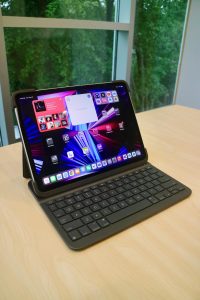
According to Principal Baldassano, “As we are now a 1:1 with district devices, our expectation is that students use the iPad they are issued for work while in school, making the Guest Wi-Fi unnecessary…it allows our IT Department to take measures to enhance our network security..”
But some students are disappointed in the new policy. PHS junior Jana Matar says, “Like so many others, I personally miss bringing my laptop to school and being able to work off of there. Not only did it provide me with a more efficient device and the ability to choose how I want to do my work, but it also made me more productive in class. Compared to when I am forced to use my iPad, I complete my work almost twice as fast on my laptop and feel better about what I have written down.”
Some of the biggest concerns of being a BYOD school were increased security breaches and a lack of being able to monitor student activity on the school’s part, which is a huge concern for education. In fact, a law was passed in 2000 called the Children’s Internet Protection Act (CIPA), which requires schools and libraries to provide “technology protection measures” when providing internet to minors.
By getting rid of the Guest Wi-Fi, the administration argues that we are helping to erode plagiarism and and providing a safe environment for internet access in schools.
While many students miss their MacBooks, they have to admit that cheating and software breaches have gone up astronomically in the past couple of years. AI usage in writing is a serious issue – according to the College Board, the majority of high school students now use generative AI for schoolwork. Students can find ways to cheat on a personal device much more easily than on a district-controlled device, because at the end of the day, they take their secrets home with them.
When students just use their ipads, this can create a safer network environment, and many NJ schools have already been targets of cyberattacks. There have been numerous stories not only at school, but also in the workplace, where people bring their own devices to work, without updating them and letting hackers in. In workplaces, it might be easier to get someone to update their laptop because they are adults and know the consequences, but it is much harder to get 500-1,000 kids to stay on top of their software updates and malware protections when they barely update their phones and school iPads.
On the other hand, there are benefits that come with letting students work on their own devices. In fact, sources agree that the use of BYOD (bring your own device) being implemented in colleges actually benefits students and the school in multiple ways. There is less of a learning curve when using the device, as the student is already familiar with the software and how it works; it is cost-efficient for the school itself, helping with budget cuts that almost 80% of schools face; and it can lead to higher student productivity as students will enjoy working on their own devices more.
Although BYOD can save districts money by not having to purchase devices for all students, it also brings up a question of equity, and if students from wealthier backgrounds may have an unfair technological advantage.
Some students suggested a compromise on both sides: accessing guest wifi could be an exclusive upperclassmen privilege, or it could be a privilege that students could earn by maintaining a strong academic record. By offering this option, it could give students an incentive not to misbehave and to maintain a good standing in their classes.
Regardless of the various opinions, the new policy looks like it is here to stay.